-
By 2035, technological innovations are expected to significantly improve the taste, functionality and economic viability of dairy product alternatives.
A stronger shift in consumption towards these products would make it easier to achieve societal sustainability goals. However, this development may also pose challenges for dairy farms in Germany. So far, there has been little debate on how a policy framework could help harness opportunities, address challenges and take tradeoffs into account.
-
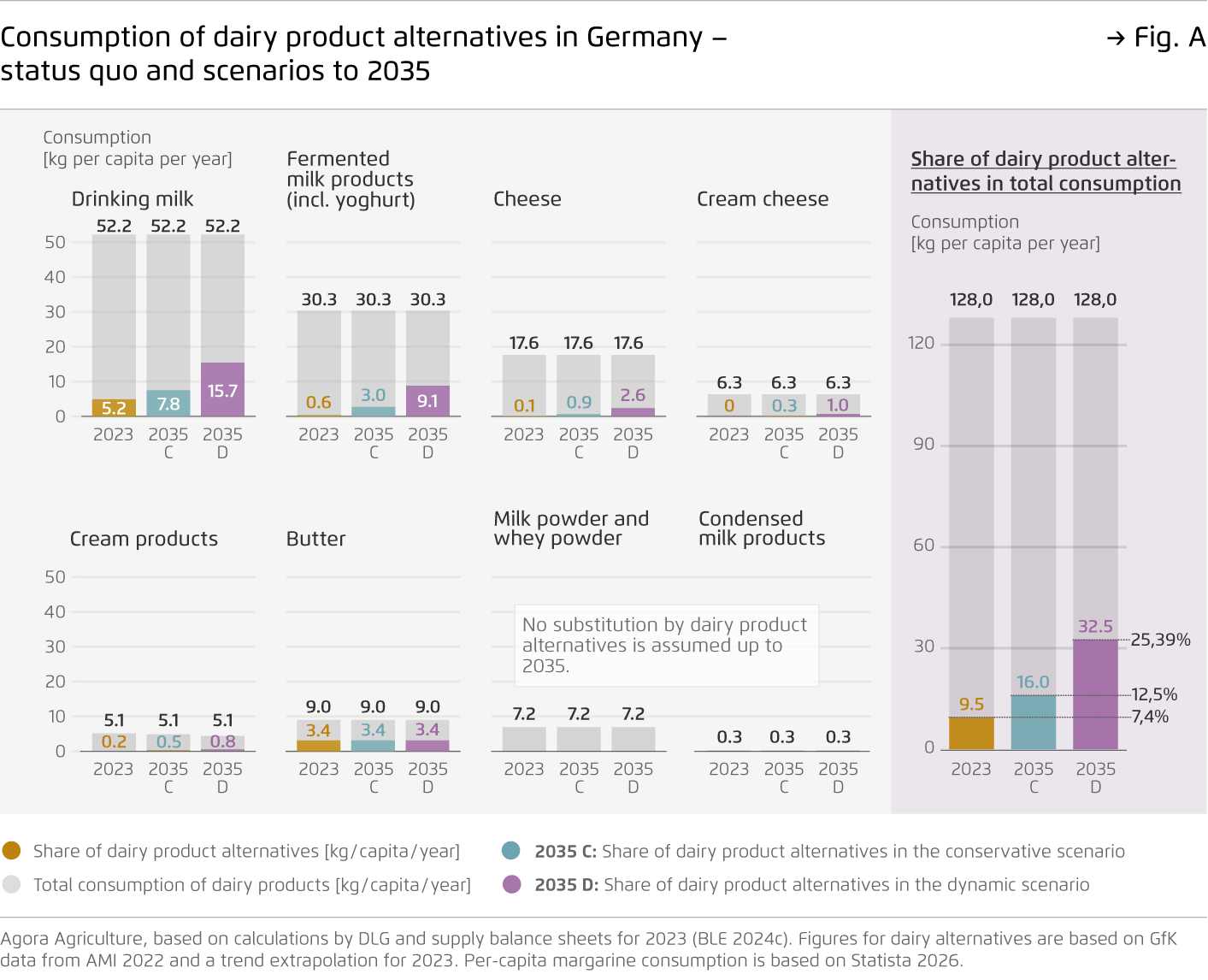
Depending on the scenario, dairy product alternatives could account for between 12 percent ( conservative scenario) and 25 percent (dynamic scenario) of total consumption in Germany by 2035,
driven primarily by growth in milk, cream and yoghurt alternatives. Plant-based alternatives are expected to continue shaping the market. From 2035 onwards, precision fermentation could provide further impetus to market development by enabling products with functional properties comparable to those of animal-based milk.
-
If domestic demand for cow’s milk declines without a corresponding increase in exports, structural change could accelerate, putting smaller and less competitive farms under greater pressure.
The extent to which changing demand affects individual farms in Germany will depend primarily on their competitiveness and on international demand. At the same time, dairies could diversify their portfolios through dairy alternatives and help preserve value creation in rural areas.
-
Technological advances and changing consumption patterns are expected to bring lasting changes to the dairy market.
Policymakers in Germany should proactively guide this transition to provide planning certainty for dairy farms, dairies and producers of dairy product alternatives.
This content is also available in: German
Dairy product alternatives
Demand development and potential implications for the dairy market in Germany
Overview
In this study, Agora Agriculture, the DLG – German Agricultural Society (Competence Center for Agriculture and Food) and the University of Hohenheim (Department of Agricultural Markets) present scenarios for the development of the market for alternative dairy products in Germany in 2035. Alternative dairy products such as oat drink, soya yoghurt or cheese alternatives based on new fermentation technologies could account for between 12.5 and 25 per cent of total dairy consumption in Germany by 2035.
The extent to which changing demand affects individual farms in Germany will depend primarily on their competitiveness and on international demand. If exports can fully offset the decline in domestic demand, production will remain unchanged. Without this offset, production could fall by 5.5 per cent by 2035 compared with 2023 in the conservative scenario, and by 19.4 per cent in the dynamic scenario.
Key findings
Bibliographical data
Downloads
-
Summary
pdf 757 KB
Dairy product alternatives
Demand development and potential implications for the dairy market in Germany
All figures in this publication
Consumption of dairy product alternatives in Germany – status quo and scenarios to 2035
Figure A from Dairy product alternatives on page 7